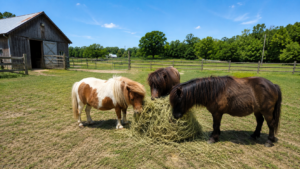
How much hay does a horse eat? As a rule of thumb, a horse needs about 1.5 to 2 percent of its body weight in forage every day. For a typical 1,000-pound horse, that means roughly 15 to 20 pounds of hay daily when pasture is limited or unavailable. Getting this number right keeps your horse healthy and helps you plan and budget your hay purchases with confidence.
This guide breaks down the rule of thumb, works through a real example, covers the factors that move the number up or down, and shows how to turn daily pounds into bales per week and month. For an exact ration tailored to your horse, your veterinarian is the best resource.
The Rule of Thumb: 1.5 to 2 Percent of Body Weight
Horses evolved as grazers, designed to eat small amounts of forage almost continuously throughout the day. Their digestive systems work best with a steady supply of hay or pasture, not large, infrequent meals. That biology is behind the standard guideline you will hear from vets and equine nutritionists: feed roughly 1.5 to 2 percent of body weight in forage per day.
Forage means hay plus any pasture the horse grazes. For horses with no grass access, hay needs to cover that entire amount. Most healthy adult horses do well somewhere in that 1.5 to 2 percent range, with easy keepers on the lower end and hard keepers or working horses on the higher end.
A Worked Example for a 1,000-Pound Horse
Numbers make this concrete. Take an average adult horse weighing about 1,000 pounds:
- At 1.5 percent of body weight: 1,000 x 0.015 = 15 pounds of hay per day.
- At 2 percent of body weight: 1,000 x 0.02 = 20 pounds of hay per day.
So a 1,000-pound horse with little or no pasture typically eats somewhere around 15 to 20 pounds of hay per day. A larger 1,200-pound horse would need proportionally more, roughly 18 to 24 pounds, while a 900-pound horse would need less.
If you are not sure what your horse weighs, a weight tape or your vet’s scale gives you a far better starting point than a guess. The daily amount is only as accurate as the weight you plug into it.
Factors That Change How Much Hay a Horse Needs
The rule of thumb is a starting point, not a fixed prescription. Several factors push a horse’s hay needs up or down:
- Work level. A horse in regular training or hard work burns more energy and needs more forage and calories than an idle pasture companion.
- Cold weather. Digesting hay produces body heat, so horses need more forage in winter to stay warm. Extra hay, not extra grain, is the right way to help a horse hold condition through a cold New York winter.
- Pasture access. A horse on good summer grass may need little or no supplemental hay. When pasture is dormant, snow-covered, or overgrazed, hay makes up the difference.
- Age and health. Growing youngsters, pregnant or nursing mares, and hard-keeping seniors often need more. Overweight horses and easy keepers may need carefully controlled amounts.
- Hay quality. Richer, leafier hay delivers more nutrition per pound than mature, stemmy hay, which affects how much a horse needs to meet its requirements.
Cornell Cooperative Extension and university equine programs publish helpful guidance on adjusting forage for weather, workload, and life stage. Use these factors to fine-tune within and sometimes beyond the 1.5 to 2 percent range.
Free-Choice Versus Measured Meals
Once you know the daily amount, you can decide how to deliver it. Many horses do best with hay available most of the time, which mirrors their natural grazing pattern and helps prevent digestive upset and stall boredom. This is the “always something to nibble” principle.
Easy keepers and overweight horses are the exception. For them, free-choice hay can lead to unwanted weight gain, so measured meals or slow-feed nets that stretch a controlled amount across the day work better. Slow-feeders are a useful middle ground: they extend eating time without increasing the total pounds fed.
Whatever method you choose, split hay into several feedings when you can rather than one large drop, and never let a horse stand for long stretches with no forage at all.
Turning Pounds Into Bales for Planning and Budget
To buy hay sensibly, convert the daily amount into bales. Small square bales commonly weigh somewhere around 40 to 50 pounds, though this varies a lot by grower, cut, and moisture, so weigh a few of your own bales to be sure.
Using a 50-pound bale and a horse eating 18 pounds a day as an example:
- Per day: about 18 pounds, roughly a third of a bale.
- Per week: about 126 pounds, or a little over 2.5 bales.
- Per month: about 540 pounds, or roughly 11 bales.
- Per year: in the neighborhood of 130 to 135 bales for a single horse with limited pasture.
These are planning estimates, not exact figures, but they help enormously when you are deciding how much to buy and store, especially before winter when supply tightens and prices often rise. Buying a season’s worth at once can also stretch your budget. Our hay prices page can help you gauge current market rates as you plan.
Water and the Always-Forage Principle
Hay does not work alone. Two things belong alongside every forage plan:
- Clean water at all times. Horses drink many gallons a day, and adequate water intake is essential for digesting hay and preventing impaction colic, especially in cold weather when horses may drink less.
- Steady access to forage. Because a horse’s stomach produces acid continuously, long empty stretches raise the risk of ulcers and other problems. Keeping forage in front of your horse for most of the day protects gut health.
Get the water and always-forage basics right, and the daily hay math has a much better chance of keeping your horse in good shape.
Plan Your Hay With Confidence
Feeding a horse well comes down to a simple foundation: around 1.5 to 2 percent of body weight in forage daily, roughly 15 to 20 pounds of hay for a 1,000-pound horse, adjusted for work, weather, pasture, and the individual animal. Convert that into bales and you can plan purchases for the week, the month, and the whole winter without scrambling. For a precise ration tailored to your horse’s weight, age, and health, talk with your veterinarian.
When you are ready to stock up, Empire State Haymarket connects you with New York growers offering quality forage. Browse horse hay and current hay for sale listings, compare options, and buy the hay your horse needs directly from local producers.