The best hay for donkeys is mature, coarse, low-sugar grass hay fed in carefully controlled amounts. Donkeys are not small horses. They evolved in dry, sparse country where food was scarce, so they are remarkably efficient at turning modest forage into body weight. Get the hay wrong and a donkey gains pounds fast; get it right and you have a healthy, contented animal on a simple diet.
Why Donkeys Need a Different Kind of Hay
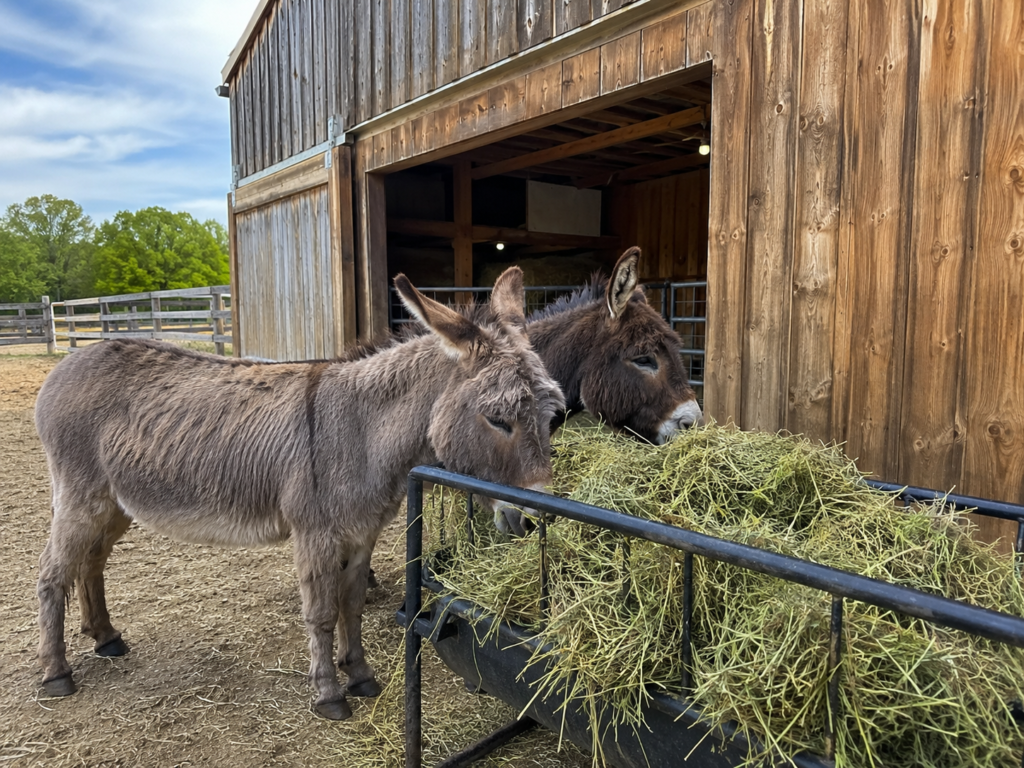
Donkeys trace back to the arid regions of North Africa, where forage was tough, fibrous, and thin on the ground. That heritage still shapes how they eat today. A donkey can extract more nutrition from poor-quality roughage than a horse can, which sounds like an advantage until you feed one like a horse.
On rich hay or lush pasture, most donkeys pile on weight quickly. That extra weight brings real risk. Donkeys are prone to obesity, laminitis (a painful, sometimes crippling hoof condition), and hyperlipemia, a serious metabolic problem that can come on when an overweight donkey goes off its feed. Because of this, the goal with donkey hay is almost the opposite of what you’d want for a hard-working horse: plenty of fiber, plenty of chew time, and very little sugar or calorie punch.
The Donkey Sanctuary, a UK welfare and research organization, has long recommended that most healthy donkeys do best on high-fiber, low-energy forage rather than the richer feeds marketed for horses. That principle guides everything below.
The Best Hay for Donkeys: Mature Grass Hay
For most donkeys, the foundation should be clean, mature grass hay. “Mature” is the key word. Hay cut later in its growth, when the grass has already gone to seed and coarsened, carries more fiber and fewer sugars than young, leafy hay. That coarser texture also makes a donkey chew longer, which is good for both its gut and its state of mind.
In New York, this usually points you toward a first cutting. First cutting is the season’s initial harvest, and it tends to be stemmier and higher in fiber than the softer, richer growth that follows. It isn’t low quality; it’s simply better matched to an animal that needs bulk without a calorie load. If you want a fuller comparison of the two, our guide on first cutting vs. second cutting hay breaks it down.
What to look for in donkey hay:
- Coarse and stemmy: More mature grass, not soft leafy growth.
- Low sugar: Avoid rich, lush hay and anything cut very young.
- Clean and dry: No mold, no dust, no musty smell — donkeys have sensitive lungs too.
- Grass, not legume: Skip alfalfa for most donkeys; it’s far too rich (more on that below).
Where Barley Straw Fits In
Here’s where donkey feeding differs from most horses. Many donkeys do well with clean barley straw mixed into their ration. Straw is very high in fiber and very low in calories, so it adds chew time and gut fill without adding weight. For an easy keeper that needs to eat something most of the day, that’s genuinely useful.
A common approach is to offer good grass hay alongside clean straw, letting straw make up a portion of the daily forage for donkeys that need to lose or hold weight. Introduce straw slowly, make sure teeth are in good shape first (poor teeth can’t chew it properly), and always check with your vet before leaning heavily on straw. If you’re new to it, our overview of straw covers what to look for in a clean batch.
Hay to Avoid: Rich Second Cutting and Alfalfa
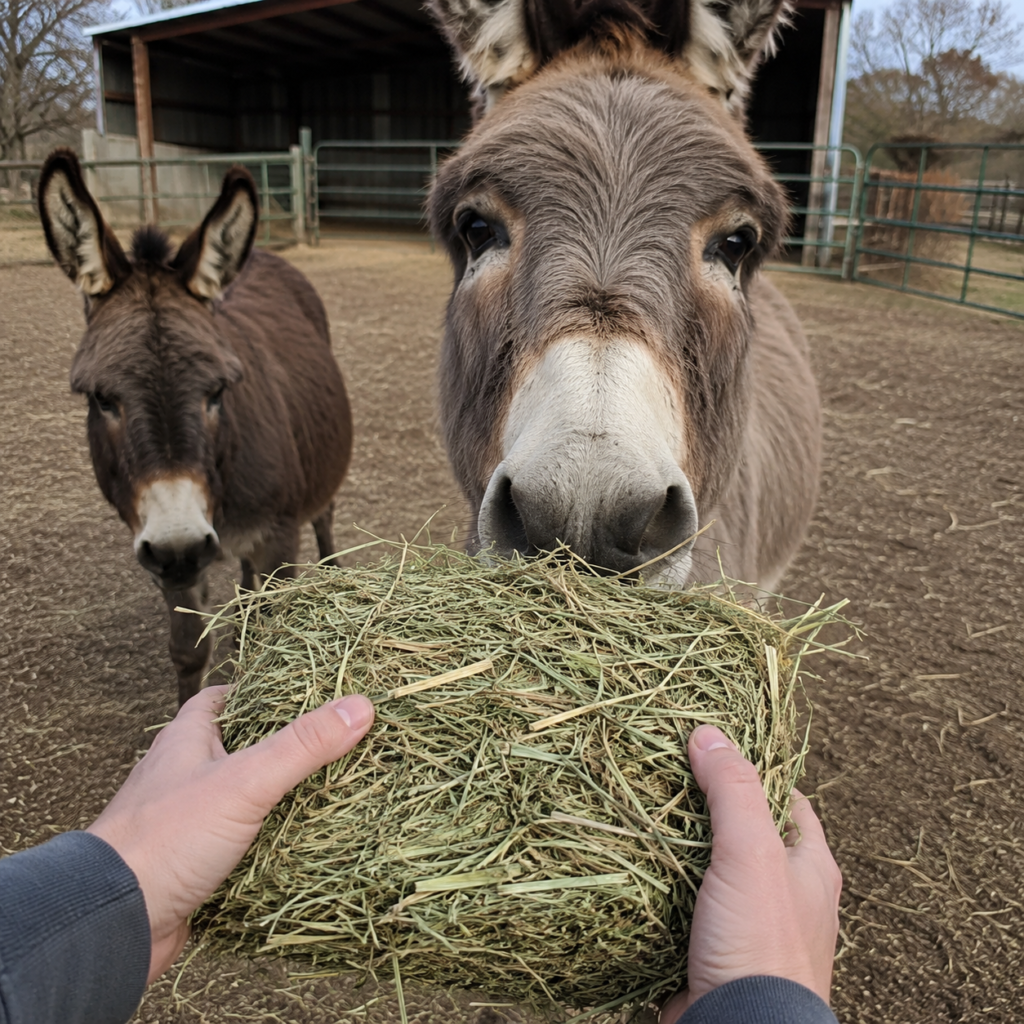
For the average healthy donkey, two things are usually too much: rich second-cutting hay and alfalfa.
Second cutting is typically leafier, softer, and higher in sugar and energy than first cutting. Horses in hard work may need that. A backyard donkey almost never does. Alfalfa is a legume, not a grass, and it’s loaded with protein, calcium, and calories — excellent for a growing horse or a nursing mare, but a fast track to obesity for a donkey. This is one of the clearest differences between feeding a donkey and feeding a horse. If you also keep horses, our guide to the best hay for horses shows why the same alfalfa that helps a sport horse works against a donkey.
None of this is absolute. A donkey recovering from illness, an underweight rescue, or an old animal with worn teeth may need richer forage under a vet’s guidance. But for a healthy adult donkey holding good condition, mature grass hay does the job.
How Much Hay to Feed a Donkey
Feed donkeys by weight, not by the flake or the armful. As a general starting point, many donkeys do well on roughly 1.5% of their body weight in dry forage per day, adjusted up or down based on body condition. For a 400-pound donkey, that’s about 6 pounds of hay and straw combined daily — far less than a full-size horse eats.
Think of that figure as a starting estimate, not a fixed rule. A donkey carrying too much weight may need less, and one that’s too thin may need more or richer feed. Weigh the hay on a simple scale so you actually know what you’re giving, and use a body condition score to check whether it’s working. Splitting that ration across the day, or slowing it down with a small-hole net, keeps a donkey chewing for hours without overfeeding — which matters, because donkeys are smart animals that get bored and stressed with nothing to nibble.
Because obesity, laminitis, and hyperlipemia are all serious, always work with your veterinarian to set the right amount and to plan any weight-loss diet safely. Cutting a donkey’s feed too fast can do real harm.
Storing and Sourcing Donkey Hay in New York
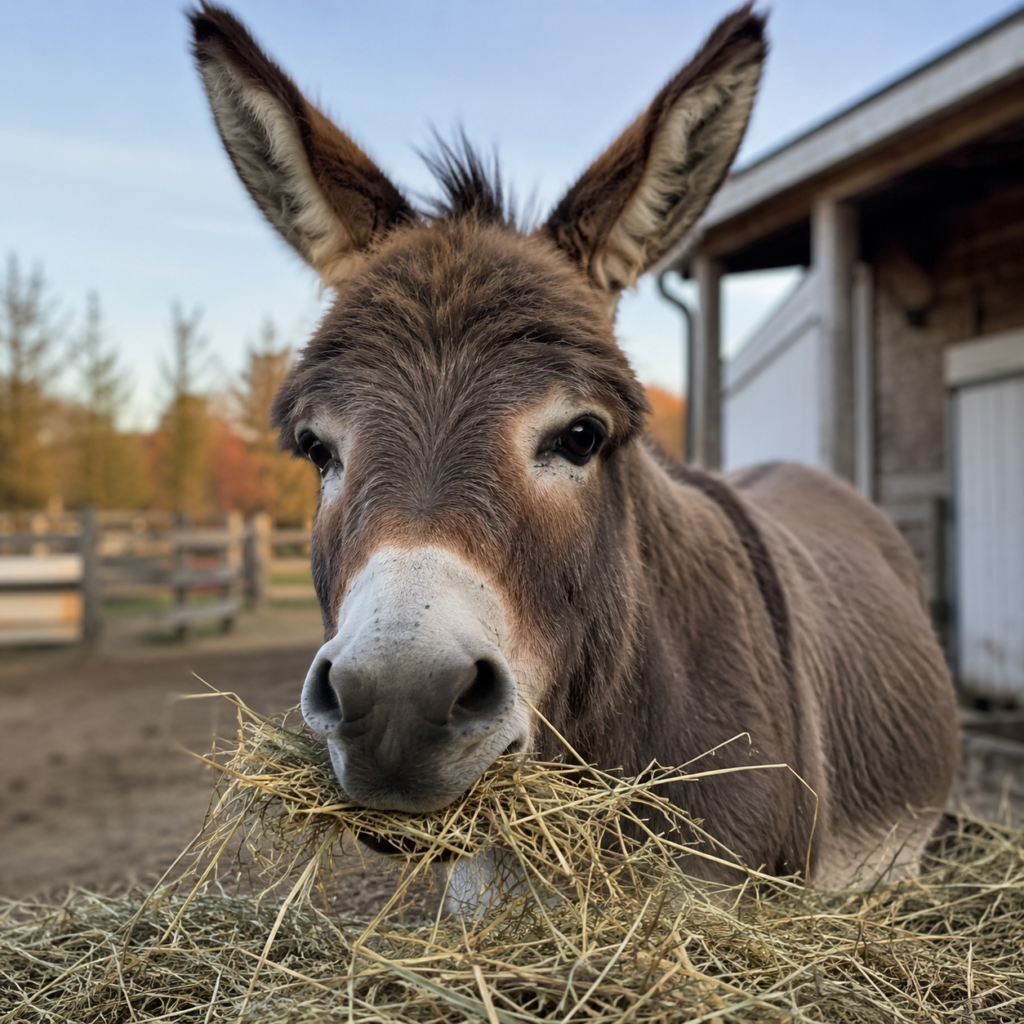
Good donkey hay stays good only if you store it well. Keep bales off the ground and under cover, with airflow around them, so they don’t draw damp and turn moldy over a New York winter. Moldy hay is a risk for any equine, and donkeys are no exception. Our guide on how to store hay walks through keeping a season’s supply sound.
Sourcing locally makes this easier. Buying from a nearby NY grower means you can look at the bales in person, ask when it was cut, and confirm it’s the coarse, mature grass hay your donkey needs — not the soft, rich stuff. It also trims trucking cost, since hay is heavy and freight adds up fast.
Match the Hay to the Donkey
The best hay for donkeys is mature, coarse, low-sugar grass hay — often a first cutting — fed by weight in controlled amounts, sometimes stretched with clean barley straw for chew time and fiber. Skip the rich second cutting and alfalfa for most animals, weigh what you feed, and lean on your vet for weight or laminitis concerns. Feed a donkey like the efficient desert animal it is, and you’ll keep it sound and content.
Ready to find the right forage from local New York growers? Browse current listings on our hay for sale page, or post a hay wanted request and let nearby sellers bring the coarse, mature hay your donkey needs right to you.
This guide is part of our complete guide to the best hay for every animal.
Ready to buy? Browse hay for donkeys for sale in New York from local farms on Empire State Haymarket.


